

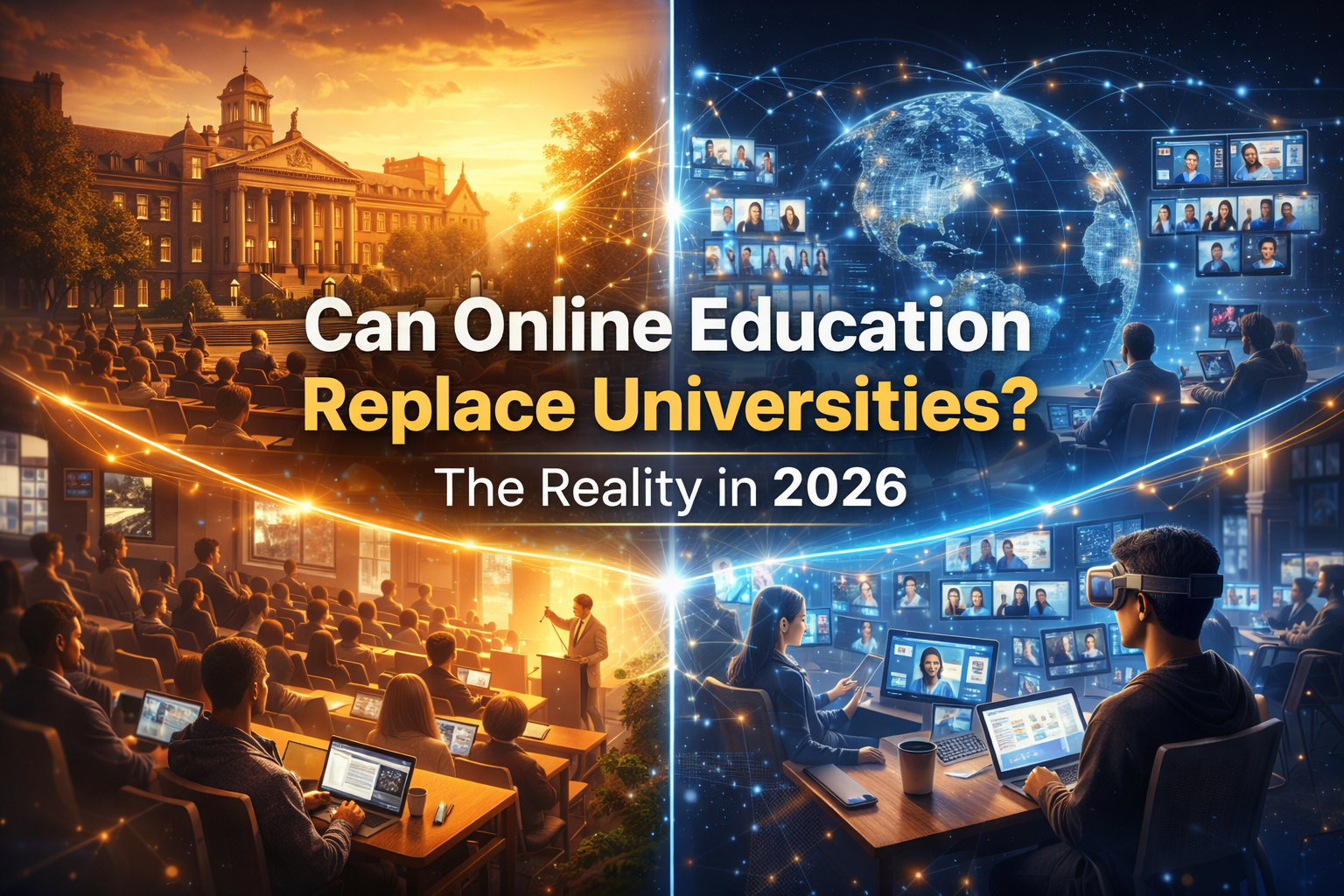
The global education system is undergoing a major transformation as digital learning platforms continue to expand rapidly. With advancements in artificial intelligence, virtual classrooms, and remote collaboration tools, many students and professionals are questioning whether online education can replace traditional universities.
In 2026, the debate is no longer about whether online learning is effective — it is about how far it can go in reshaping higher education. This article explores the reality of online education’s role in the future and whether universities will remain relevant in the digital age.
The Rise of Online Education in the Digital Era
Online education has experienced exponential growth over the past decade. Massive open online courses (MOOCs), virtual degree programs, and AI-powered learning platforms have made higher education more accessible than ever.
Students can now gain knowledge from global institutions without relocating, reducing financial barriers and geographical limitations. As a result, digital education has become a powerful alternative to traditional campus-based learning.
However, accessibility alone does not determine whether online education can fully replace universities.
Advantages of Online Education in 2026
1. Flexibility and Accessibility
Online learning allows students to study at their own pace and schedule, making education more inclusive for working professionals and non-traditional learners.
2. Cost Efficiency
Digital degree programs often cost significantly less than traditional university education, reducing student debt and financial pressure.
3. Global Learning Opportunities
Students can connect with instructors and peers worldwide, enhancing cultural understanding and collaborative learning experiences.

Limitations of Online Education Compared to Universities
Despite its advantages, online education still faces challenges that limit its ability to fully replace traditional universities.
4. Lack of Hands-On Learning
Practical disciplines such as medicine, engineering, and laboratory sciences require physical infrastructure and real-world experimentation.
5. Reduced Social Interaction
University campuses provide networking opportunities, extracurricular activities, and social development experiences that are difficult to replicate in virtual environments.
6. Perception and Accreditation Issues
While digital credentials are gaining acceptance, some employers and institutions still prioritize traditional university degrees.
The Role of Universities in a Digital Future
Universities are evolving rather than becoming obsolete. Many institutions are adopting hybrid learning models that combine online platforms with on-campus experiences.
This blended approach ensures that students benefit from both digital flexibility and traditional academic environments. Universities also contribute to research innovation, knowledge creation, and professional networking — functions that extend beyond course delivery.

Technological Innovations Shaping Higher Education
Several technological advancements are influencing the future of education:
- AI-driven personalized learning systems
- Virtual reality (VR) classrooms
- Blockchain-based academic credential verification
- Data-driven curriculum design
- Global remote collaboration tools
These innovations are redefining how universities operate, making education more adaptive and future-oriented.
Can Online Education Fully Replace Universities?
The reality in 2026 suggests that online education will not completely replace universities. Instead, it will transform the higher education ecosystem by introducing new learning models and expanding access to knowledge.
Traditional universities provide structured academic environments, social experiences, and research opportunities that digital platforms cannot fully replicate. However, online education will continue to play a crucial role in lifelong learning and professional skill development.
The Future: Hybrid Learning as the New Standard
Hybrid education models are expected to dominate the future of higher education. These systems integrate online learning flexibility with campus-based interaction and experiential learning.
Students will increasingly choose educational pathways that combine digital courses, micro-credentials, and traditional degrees to build comprehensive skill sets.
Final Thoughts
Online education is reshaping the academic landscape, but it is not replacing universities — it is redefining their purpose. In 2026, higher education is becoming more flexible, accessible, and technology-driven.
The future lies in collaboration between digital learning platforms and traditional institutions, creating a balanced and inclusive educational ecosystem.
By embracing innovation while preserving the strengths of conventional education, society can ensure that higher learning continues to evolve and meet the needs of future generations.