

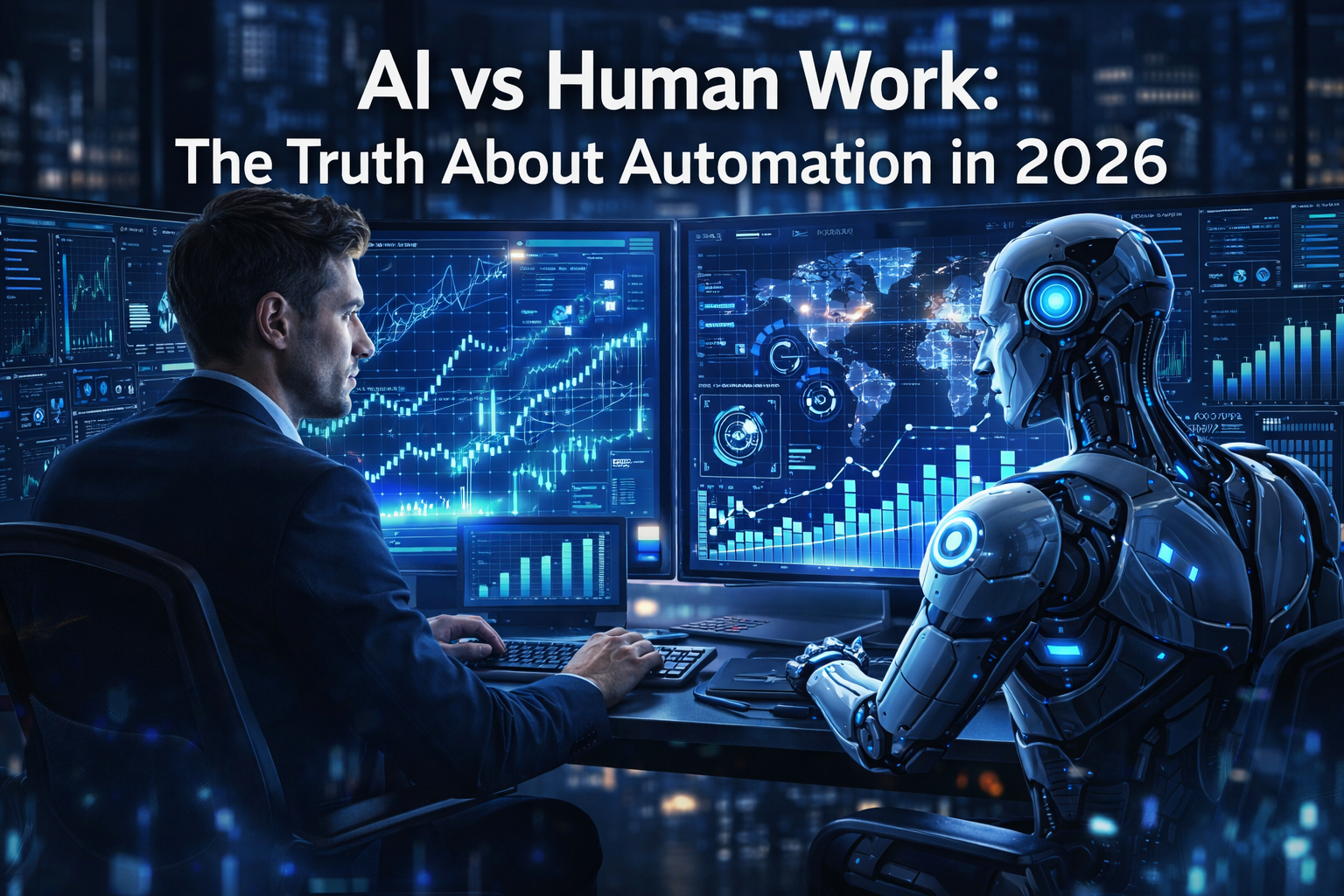
Automation is no longer a distant possibility.
It’s already shaping how businesses operate, how professionals build careers, and how economies grow. In 2026, the conversation around AI vs human work has moved beyond fear and hype into something more nuanced — adaptation.
The real story is not about machines replacing people.
It’s about how intelligent systems are redefining the value of human contribution.
Understanding this shift is essential for anyone navigating the modern digital economy.
The Automation Reality: Beyond Job Replacement
Automation used to be associated with factory robots and repetitive industrial tasks.
Today, AI systems analyze data, generate creative outputs, and even make strategic decisions.
This evolution has led to a critical misconception:
That automation will eliminate the need for human work entirely.
In reality, AI is reshaping roles rather than removing them.
Organizations are increasingly adopting AI to:
- Improve operational efficiency
- Reduce decision-making delays
- Enhance customer experience
- Identify new market opportunities
Human expertise remains crucial in interpreting insights, setting ethical frameworks, and building innovative strategies.
How AI Is Transforming Work Structures
The structure of employment is undergoing a gradual transformation.
From Task-Based Work to Skill-Based Contribution
Routine activities are being automated, while strategic and creative roles are expanding.
From Fixed Jobs to Fluid Career Paths
Professionals are shifting between roles as industries integrate automation.
From Individual Output to Human-AI Collaboration
Success increasingly depends on how effectively individuals work alongside intelligent systems.
This shift emphasizes adaptability as the most valuable professional skill.

Industries Experiencing the Biggest Automation Impact
Automation is not evenly distributed across sectors.
Finance and Data Analytics
AI-driven tools now perform complex financial modeling, risk assessment, and fraud detection.
Healthcare and Diagnostics
Predictive algorithms assist doctors in making faster and more accurate decisions.
Marketing and Customer Experience
Automation personalizes consumer journeys through behavioral analysis.
Logistics and Supply Chain
AI optimizes routes, inventory management, and demand forecasting.
Each of these sectors demonstrates how automation increases efficiency while requiring human oversight.
The Psychological Shift: Redefining Work Identity
Automation doesn’t just change tasks.
It reshapes how people perceive professional value.
Many professionals initially fear losing relevance.
However, automation often removes monotonous activities, allowing deeper focus on meaningful contributions.
This transition encourages:
- Continuous learning habits
- Cross-disciplinary skill development
- Strategic thinking and creativity
- Emotional intelligence in leadership
In this context, human work evolves toward higher-order problem solving.
Economic Implications of the Automation Era
AI adoption is influencing global economic structures.
Companies leveraging automation achieve:
- Faster scalability
- Lower operational costs
- Improved innovation cycles
- Competitive market positioning
These advantages attract investment and drive the emergence of billion-dollar AI-driven enterprises.
At the same time, governments and institutions face the challenge of preparing workforces for technological integration.

Common Misconceptions About AI vs Human Work
Despite widespread discussion, several myths persist.
“AI Will Replace All Jobs”
Automation changes job structures but also creates new professional categories.
“Technical Skills Are the Only Future”
Soft skills such as creativity, adaptability, and communication remain irreplaceable.
“Automation Benefits Only Large Corporations”
Small businesses and entrepreneurs increasingly leverage AI tools to compete globally.
Understanding these realities helps professionals make informed career decisions.
Strategic Mindset for the Future Workforce
Thriving in an automated world requires intentional mindset shifts.
Professionals should focus on:
- Learning how AI tools function rather than fearing them
- Developing interdisciplinary knowledge
- Building resilience in rapidly changing environments
- Emphasizing ethical decision-making
Organizations, meanwhile, must invest in human capital development alongside technological adoption.
The Truth About Automation in 2026
The debate between AI and human work is ultimately misleading.
Automation is not an opponent.
It is a transformative force shaping new economic and professional landscapes.
The real question is not whether AI will change work.
It is how individuals and institutions will respond to that change.
Those who embrace collaboration with intelligent systems will find unprecedented opportunities for growth and innovation.