

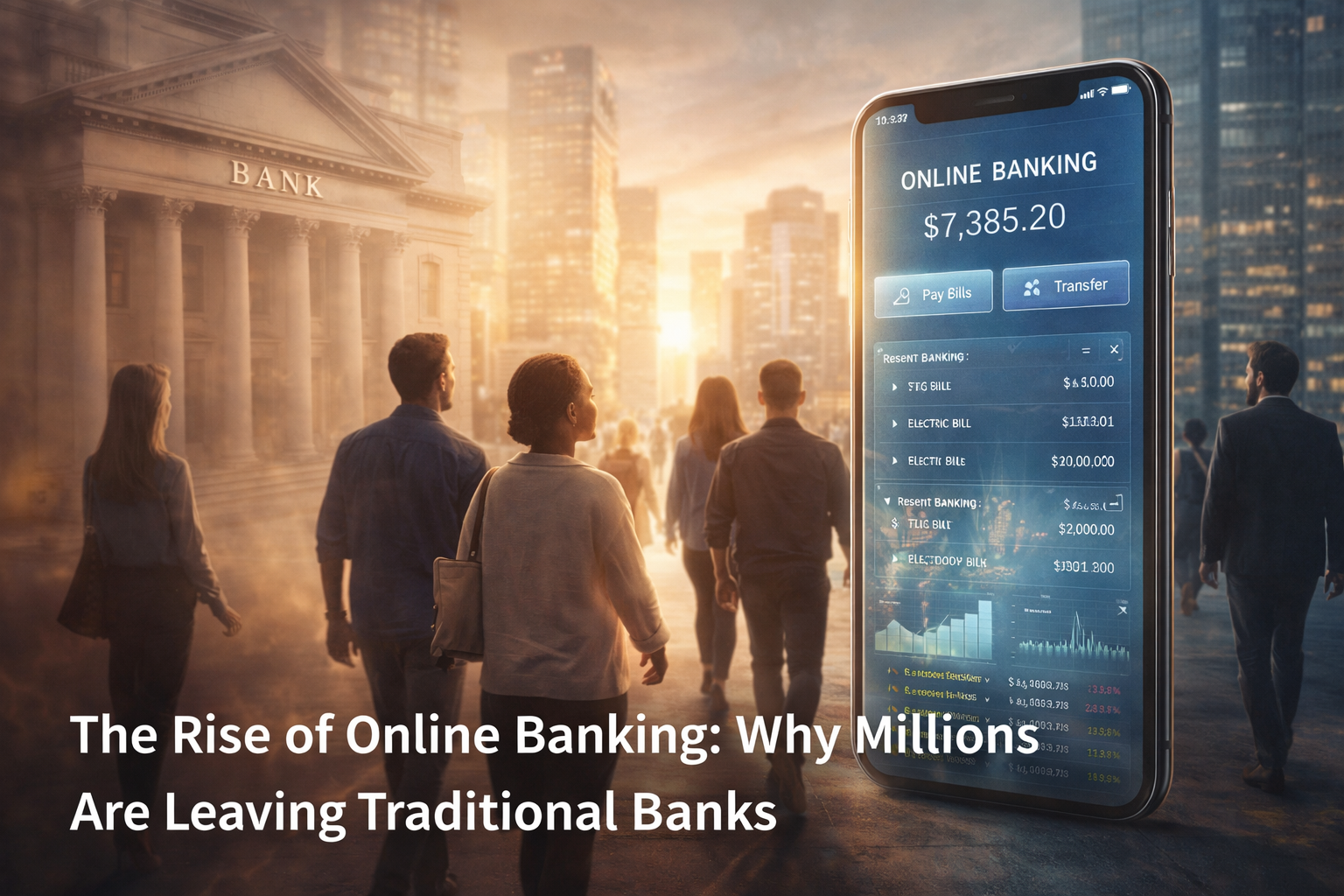
For decades, banking meant physical branches, long queues, and paperwork.
Today, the shift toward online banking is redefining how people interact with money. Millions of customers across the world are moving away from traditional banking systems in favor of digital platforms that offer convenience, speed, and control.
This transition is not just technological.
It reflects deeper changes in consumer behavior, economic expectations, and trust in financial institutions.
Understanding why millions are leaving traditional banks provides insight into the future of global financial systems.
Convenience Has Become the New Financial Standard
Modern consumers expect financial services to match the speed of their daily lives.
Online banking platforms provide instant access to accounts, transactions, and financial tools without geographic limitations.
Key convenience factors driving adoption include:
- 24/7 account access through mobile apps
- Instant fund transfers and digital payments
- Simplified account management interfaces
- Integration with financial planning tools
- Reduced dependency on physical documentation
These features align with the digital lifestyle where efficiency and immediacy are valued more than traditional institutional processes.
Trust Is Shifting from Institutions to Technology
Historically, trust in banking was built through physical presence and brand reputation.
Now, trust increasingly depends on user experience, transparency, and technological reliability.
Digital banks emphasize:
- Real-time transaction notifications
- Transparent fee structures
- Enhanced data security systems
- Personalized financial insights
- User-centric service models
This shift highlights how trust is evolving from institutional authority to technological performance.

Cost Efficiency and Financial Accessibility
Online banking platforms often operate with lower overhead costs compared to traditional institutions.
This efficiency allows them to offer:
- Reduced service fees
- Higher interest rates on savings
- Competitive loan products
- Accessible financial services for underserved populations
Financial inclusion is one of the most significant outcomes of digital banking expansion.
Individuals in remote or emerging markets can now access financial tools that were previously unavailable.
The Role of Technology in Transforming Banking Experience
Artificial intelligence, automation, and data analytics are reshaping the banking landscape.
Digital platforms now provide:
- AI-driven financial recommendations
- Automated budgeting and expense tracking
- Fraud detection through behavioral analytics
- Seamless integration with digital ecosystems
These innovations create a banking experience that feels personalized rather than transactional.
Customers increasingly view online banking as a financial partner rather than just a service provider.

Changing Consumer Expectations and Lifestyle Patterns
The rise of remote work, digital entrepreneurship, and global mobility has reshaped financial needs.
Consumers now prioritize:
- Cross-border financial flexibility
- Instant payment solutions
- Digital investment platforms
- Integrated financial planning tools
Traditional banking structures often struggle to adapt quickly to these evolving expectations.
Online banking platforms, designed for agility, are better positioned to meet modern financial lifestyles.
Security Concerns and the Balance of Digital Trust
While online banking adoption is increasing, security remains a key consideration.
Financial institutions invest heavily in:
- Biometric authentication systems
- Advanced encryption protocols
- AI-driven fraud prevention
- Continuous cybersecurity monitoring
Users are becoming more aware of digital risks and are adopting safer financial behaviors.
Trust in digital banking grows when security measures are both robust and transparent.
Economic Implications of the Digital Banking Shift
The movement toward online banking is influencing broader economic structures.
Key implications include:
- Reduced operational costs for financial institutions
- Increased competition within the banking sector
- Acceleration of fintech innovation
- Expansion of global digital financial ecosystems
These changes suggest that online banking is not merely a consumer trend but a structural economic transformation.
The Future of Banking in a Digital World
As technology continues to evolve, the distinction between traditional and digital banking may eventually disappear.
Future developments could include:
- Fully AI-managed financial services
- Integration of digital currencies into mainstream banking
- Expansion of decentralized financial platforms
- Personalized financial ecosystems powered by data analytics
The rise of online banking represents a shift toward more accessible, efficient, and adaptive financial systems.
A Thoughtful Perspective on Financial Transformation
The transition from traditional to online banking reflects broader societal changes in how trust, convenience, and financial empowerment are perceived.
Individuals are not simply choosing digital platforms because they are modern.
They are choosing them because they align with contemporary economic realities.
As digital financial ecosystems mature, understanding this transformation will be essential for navigating future financial opportunities.
Online banking is not just changing where we manage money.
It is reshaping how we understand financial independence.