

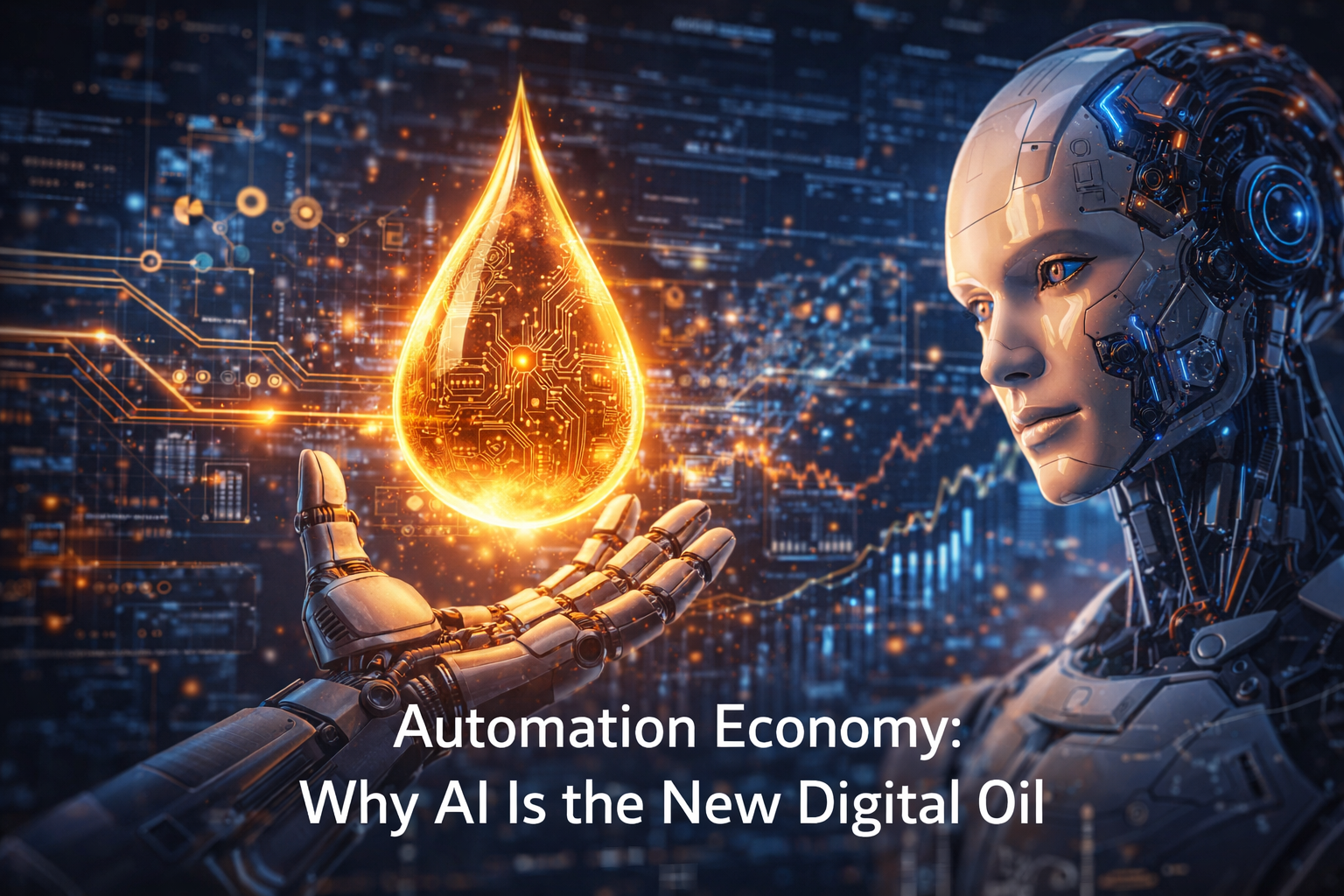
Every economic era has been defined by a core resource.
The industrial revolution had coal. The late twentieth century revolved around oil. In 2026, the world is increasingly shaped by something less visible but far more powerful — artificial intelligence.
The idea that AI is the new digital oil is no longer a metaphor.
It reflects how data-driven automation is fueling productivity, innovation, and economic transformation across industries.
Automation is not simply replacing tasks.
It is becoming the engine that drives global economic value creation.
The Rise of the Automation Economy
The automation economy refers to a system where intelligent machines, algorithms, and data networks significantly influence how businesses generate value.
This transformation is happening because AI enables organizations to:
- Scale operations without proportional workforce expansion
- Predict market trends with unprecedented accuracy
- Optimize supply chains in real time
- Personalize customer experiences at scale
- Accelerate innovation cycles
Companies that effectively leverage automation technologies often outperform competitors, not because they have more resources, but because they deploy resources more intelligently.
The result is an economic shift where efficiency and intelligence become the primary drivers of growth.
Why AI Is Compared to Oil
Historically, oil powered physical economies by enabling transportation, manufacturing, and energy production.
AI plays a similar role in digital economies by:
- Powering data-driven decision making
- Enabling automation of complex processes
- Fueling new digital business models
- Supporting global connectivity and scalability
However, unlike oil, AI improves with use.
The more data systems process, the more valuable they become.
This self-reinforcing cycle makes AI a uniquely transformative resource.

Industries Leading the Automation Revolution
Automation is not confined to technology firms.
Its influence spans nearly every sector of the global economy.
Finance and Investment
AI systems analyze vast datasets to identify investment opportunities, manage risks, and automate trading strategies.
Healthcare and Biotechnology
Predictive analytics improve diagnostics and accelerate drug discovery.
Manufacturing and Logistics
Smart factories use robotics and AI to optimize production and reduce operational inefficiencies.
Retail and Consumer Experience
Personalization algorithms transform how brands interact with customers.
These shifts illustrate how automation is reshaping both productivity and competitive advantage.
Economic Power Concentration and New Opportunities
While automation creates opportunities, it also raises questions about economic concentration.
Technology-driven firms often achieve rapid scalability, leading to significant market influence.
However, automation also lowers barriers to entry for entrepreneurs.
Small teams can now:
- Launch global digital platforms
- Build AI-driven services
- Access cloud infrastructure
- Compete with established corporations
This dual dynamic defines the automation economy — concentrated power alongside democratized innovation.
Workforce Transformation in the Age of Automation
The automation economy is reshaping employment patterns.
Routine tasks are increasingly automated, while demand grows for roles involving:
- Strategic thinking
- Creativity and innovation
- Data interpretation
- Ethical technology governance
Rather than eliminating human work, automation is redefining its nature.
Professionals who develop adaptable skillsets and embrace lifelong learning are better positioned to thrive.
This shift reflects a transition from labor-centric economies to knowledge-centric economic systems.
Investment Trends and Global Economic Impact
Global investment patterns indicate strong confidence in automation technologies.
Capital flows into:
- AI infrastructure and cloud computing
- Autonomous systems and robotics
- Digital financial platforms
- Smart city and sustainability technologies
These investments suggest that automation will remain a central pillar of economic growth for decades.
Governments and institutions are increasingly prioritizing policies that support technological innovation while addressing social challenges.
Strategic Mindset for the Automation Era
Success in the automation economy requires more than technological adoption.
Organizations must focus on:
- Integrating AI ethically and responsibly
- Building resilient digital infrastructures
- Investing in workforce development
- Balancing efficiency with long-term sustainability
Individuals, meanwhile, should cultivate skills that complement automation rather than compete with it.
The Future of the Automation Economy
The analogy of AI as digital oil underscores a broader transformation.
Economic value is shifting from physical assets to digital intelligence.
Automation will continue to influence:
- Global trade patterns
- Productivity growth
- Wealth distribution
- Innovation ecosystems
Understanding this transition is essential for businesses, policymakers, and professionals seeking to navigate the evolving economic landscape.
The automation economy is not a temporary trend.
It represents a structural shift shaping the future of global prosperity.