

Banks feel like safe places where we store money, receive salaries, and manage payments. But behind the scenes, banks are powerful financial businesses designed to make money from the money you deposit.
Many people believe banks simply keep their money safe in a vault. In reality, banks use your deposits to generate profit in multiple ways. Understanding how this system works can help you make smarter financial decisions.
In this article, we will reveal how banks actually make money from your money and the hidden mechanisms most people never think about.
1. Banks Lend Your Money at Higher Interest
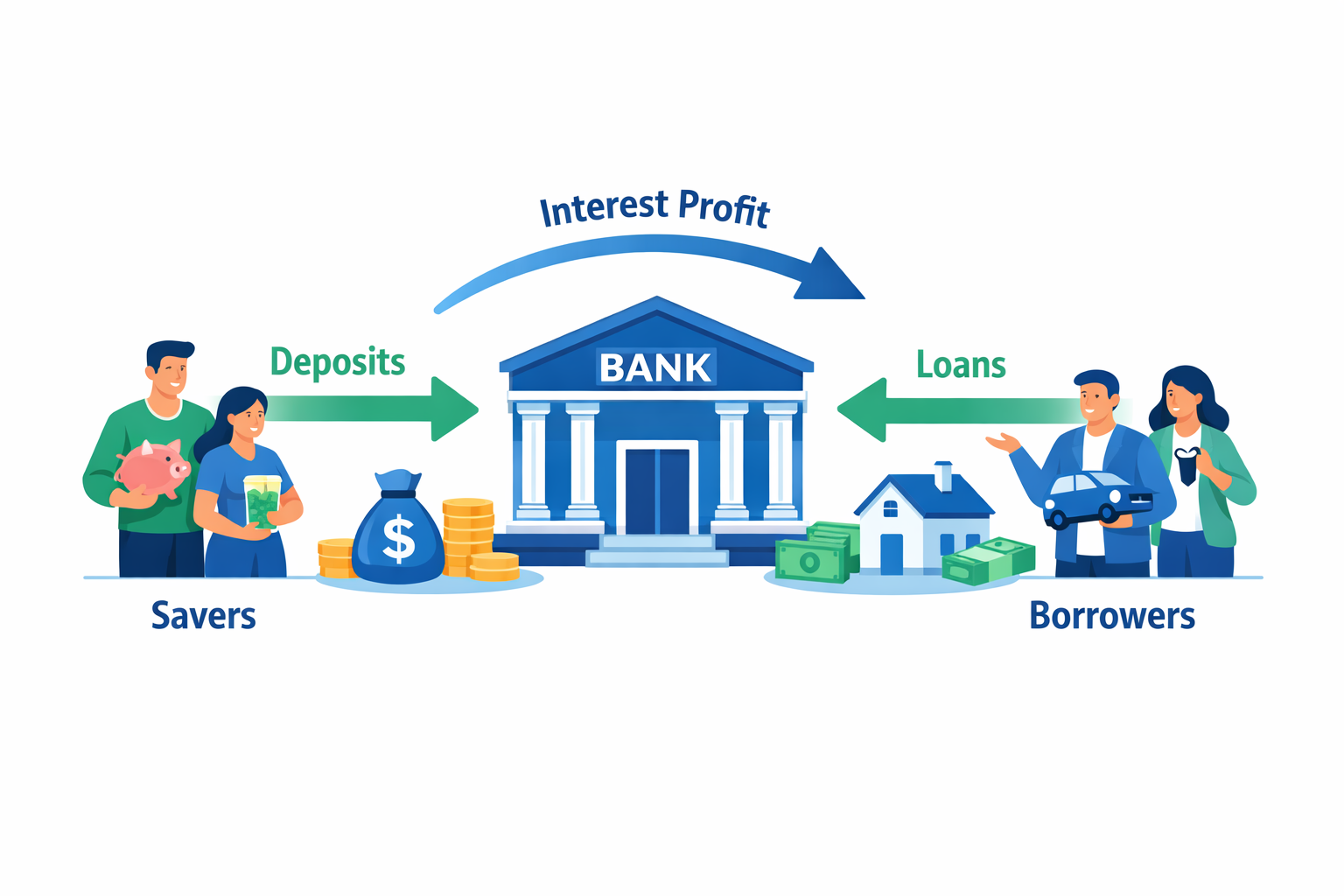
The primary way banks make money is through a system called interest spread.
When you deposit money in a savings account, the bank usually pays you a small interest rate. For example:
- Savings account interest: 1%
- Loan interest (credit cards, mortgages, personal loans): 6% – 25%
The difference between what banks pay you and what they charge borrowers is their profit.
For example:
If you deposit $10,000 into a bank:
- The bank may pay you $100 per year (1%)
- The bank can lend that same money and earn $700 or more
That difference is called the Net Interest Margin, and it is one of the biggest profit sources for banks.
Banks essentially act as middlemen between savers and borrowers, taking a margin from both sides.

2. Banks Charge Fees (Lots of Them)
Another major way banks earn money is through fees. Many of these fees are small individually but generate billions in revenue collectively.
Common bank fees include:
- Monthly account maintenance fees
- ATM withdrawal fees
- Overdraft fees
- International transaction fees
- Wire transfer fees
- Late payment fees
- Credit card annual fees
For example, if a bank charges $35 for an overdraft, and thousands of customers accidentally overdraft each month, that becomes a huge revenue stream.
Many banks rely heavily on these service charges and penalties.
This is why some banks design their systems in ways that make it easier for customers to accidentally trigger fees.
3. Banks Invest Your Deposits
Banks do not simply keep your money sitting idle. They invest a portion of deposits in financial instruments such as:
- Government bonds
- Corporate bonds
- Treasury securities
- Interbank lending markets
These investments generate steady interest income.
Large banks manage billions of dollars, so even small returns on investments can generate enormous profits.
For example:
If a bank invests $1 billion in government securities earning 4%, it makes $40 million per year.
4. Credit Cards Are Extremely Profitable
Credit cards are one of the most profitable financial products banks offer.
Why?
Because credit cards often carry very high interest rates, sometimes between 18% and 30% annually.
Banks earn money from credit cards in several ways:
- Interest on unpaid balances
- Late payment penalties
- Annual card fees
- Merchant transaction fees (paid by businesses)
Every time you swipe your credit card, the merchant pays a transaction fee of around 2–3% to the bank and payment network.
That means banks earn money even when you pay your credit card balance in full.

5. Banks Create Money Through Lending
One of the most surprising facts about banks is that they can actually create money through lending.
Banks operate under a system called fractional reserve banking. This means banks only need to keep a small percentage of deposits in reserve and can lend out the rest.
For example:
If a bank receives $1,000 in deposits, it may only need to keep $100 in reserves.
The remaining $900 can be loaned out.
When that $900 gets deposited into another bank account, it can be loaned again.
This process effectively multiplies the money supply in the economy.
While this system helps economies grow, it also means banks have enormous power in financial systems.
6. Banks Sell Financial Products
Banks also make money by selling financial products such as:
- Insurance policies
- Investment funds
- retirement accounts
- wealth management services
These services often come with management fees and commissions.
For example, if a bank manages an investment portfolio worth $100,000 and charges a 1% management fee, it earns $1,000 per year from that client.
When thousands of clients use these services, profits grow rapidly.
7. Banks Earn From Payment Networks
Every digital payment you make — whether online, via debit card, or through mobile banking — generates small processing fees.
Banks collaborate with payment networks like:
- Visa
- Mastercard
- mobile payment systems
Each transaction might only generate a few cents, but with millions of daily transactions, the revenue becomes massive.
This is why banks actively encourage cashless payments and digital banking.
The Hidden Truth Most People Don’t Realize
The banking system is designed to use money as a tool to generate more money.
Your deposits help banks:
- issue loans
- earn interest
- collect fees
- invest funds
- process payments
In other words, your money becomes part of a much larger financial engine.
This does not mean banks are doing something wrong. In fact, this system helps economies grow by funding businesses, homes, and infrastructure.
However, understanding how banks profit allows you to:
- avoid unnecessary fees
- choose better financial products
- manage debt more wisely
- make smarter banking decisions
Final Thoughts
Banks are not just safe storage for money. They are profit-driven financial institutions that use customer deposits in sophisticated ways to generate revenue.
From lending and investment to fees and credit cards, banks have multiple income streams built around your money.
The key takeaway is simple:
The more you understand how banks operate, the better you can use the financial system to your advantage instead of unknowingly paying for it.
Being financially informed helps you save more, avoid costly mistakes, and build wealth more effectively.